
Mechanism of Action

Introduction
SCRM Bio operates by engineering the physical interface between therapeutic cells and their surrounding environment. Rather than modifying the cells themselves, the platform enhances how cells attach, persist, and function after administration by optimizing the structural characteristics of the material they interact with.
Precursor Particle Formation
The process begins with precursor particles that serve as the foundation for material transformation. In their initial state, these particles exhibit relatively smooth surfaces with limited capacity for cellular interaction.
While suitable as a base material, this pre-reaction form does not provide the structural features necessary to support strong cell adhesion or long-term retention.
Bioreactor Transformation Process
The precursor particles are introduced into a controlled bioreactor environment, where they undergo a transformation that fundamentally alters their surface architecture and physical properties.
Through this process, the material develops a more complex and irregular structure, increasing its surface area and interaction potential. These surface characteristics are established through a controlled bioreactor process, as described in the Manufacturing Process section.

Surface Characteristics Development
Following transformation, the material exhibits a highly porous and irregular topology. This includes increased surface roughness, micro-scale features, and structural variability that create multiple points of contact for cells.
These features provide mechanical anchoring opportunities, allowing cells to attach more securely compared to smoother, less interactive surfaces.

Pre-Reaction (Precursor Particles)
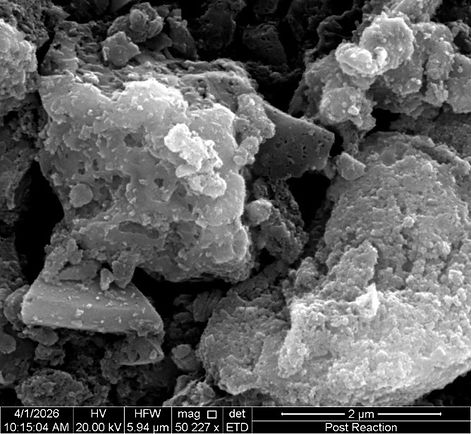
Post-Reaction (Agerea Particles)
Electron microscopy images showing precursor particles prior to bioreactor processing (pre-reaction) and the resulting Agerea particles following post-reaction modification. Post-reaction particles exhibit increased surface complexity and porosity consistent with enhanced bio-adherent properties. These structural and physical characteristics support surface-level interaction with cells and co-settling behavior with stem cells during preparation and delivery.
Density Alignment with Stem Cells
In addition to surface structure, the material is engineered to exhibit a density profile that more closely aligns with that of therapeutic cells. This alignment influences how the material behaves in suspension and during delivery.
By reducing differences in settling behavior, the material and cells remain more closely associated during administration, increasing the likelihood of interaction and attachment.
Cellular Adhesion and Retention Behavior
The combination of surface topology and density alignment creates conditions that support improved cellular adhesion and retention. Cells are more likely to attach to the material, remain in place, and maintain proximity to their intended site of action.
This interaction is expected to contribute to improved persistence of viable cells within the target environment, which is a critical factor in the effectiveness of many cell-based therapies.
Functional Integration at the Microenvironment Level
By enhancing the physical interface between cells and their surroundings, SCRM Bio supports more stable integration within the local microenvironment. This may enable cells to function more effectively by maintaining position, structure, and interaction with surrounding biological systems.
The platform’s role is therefore centered on improving the conditions in which cells operate, rather than altering the biological characteristics of the cells themselves.
Summary
The structural characteristics described here are directly observable at the microscopic level and form the basis for the platform’s performance.
Visual confirmation of these features is presented in Structural Validation.